womxn • history • sex • education • social justice

“Let Me Try That:” What Ordering a Beer May Say About Your Sex Life–and How You Embrace Your Gender
I got the idea to write this post from a friend who bartends. Alex is the nicest man you’ll ever meet and has a face everyone thinks they recognize, although he mostly just looks like Jesus. He has been in the service industry for many years and has had a first hand look at how people communicate their needs and wants in some of the most well-traveled places: bars and coffee shops.
I got the idea to write this post from a friend who bartends. Alex is the nicest man you’ll ever meet and has a face everyone thinks they recognize, although he mostly just looks like Jesus. He has been in the service industry for many years and has had a first hand look at how people communicate their needs and wants in some of the most well-traveled places: bars and coffee shops.
When I asked about how his most recent bartending job has been going, Alex responded with both positivity (he loves his job!) and some frustrations. As a sexuality educator, my ears perked up when he started explaining some themes he’d noticed while working at the bar.
“A lot of people often say, ‘Let me try that’ in reference to a beer,” Alex said. “Some people mean, ‘Let me get a sample of that, let me taste that’ but other people mean ‘Give me a whole pint of beer.’ As the bartender, I have to try to figure out what they mean.”

This kind of indirect tiptoeing around what we really mean is really common in sexual situations. For example, when we ask somebody, “Hey, do you wanna hook up?” it can be really unclear what we mean by that. Do you mean have sex? Make out? Use our fingers? What are we talking about here?
Of course I wanted to learn more. I wondered if the gender of the person asking made any difference in their language or what they meant, so I asked Alex.
“Typically, when women say ‘I want to try that,’” Alex explained, “I know they want a sample. With men, I have to clarify by asking ‘Do you want a sample or do you just want to buy the beer?’ I’m never sure what they want.”
Alex added, “Men are sometimes a little surprised when I have to clarify. They thought they were communicating perfectly.”
He thought this might be because men are generally used to getting what they want in our society, especially white men. (He said that while he didn’t have a large sample size, he’d noticed that people of color regardless of gender asked for more samples than white men do. And that older white men tended to get overwhelmed by new options and ended up sticking with the same Pilsener that they know and love.)
We do live in a patriarchal society that structurally supports white people (do I even bother citing this?) so he might not be far off….
Alex said that in his experience, “Women are more likely to try different things and when they know what they want, they’re more direct--‘I want that.’ Women get what they feel like, and men get what they know, what they’re most comfortable with.”
While of course these are gross generalizations (and how do non-binary and intersex people ask for a beer??), research has shown that men often use language to assert dominance and women tend to be “more expressive, tentative, and polite in conversation” according to some scholars (Leaper, 1991; Maltz & Borker, 1982; Wood, 1996; Mason, 1994; Basow & Rubenfield, 2003 as cited in Merchant, 2012).
According to Alex, who also works at a local cafe, these gendered trends in communication styles and decision-making manifest beyond the bar and at the coffee shop as well.
“Big groups of businessmen are always coming into the coffee shop,” said Alex, “with their briefcases and suits, and asking each other, ‘What are you getting? What are you getting?’ Then they get whatever everybody else gets, which is usually a black coffee.”
He’s even seen guys get a black coffee and then pour out half of it to add sugar and milk, rather than order a sweetened latte or cappuccino.
I do kinda love the image of big businessmen looking frantically around at whatever everybody else is getting to know what they should order.

It seems to me that in a lot of ways, traditional gender roles are showing up in how we order beers and coffee. According to societal expectations, men are supposed to know and like beer, to be assertive and confident, to know what they want and get it quickly and easily. Men also hold more positions of power and therefore are perhaps more accustomed to having individuals know what they want and need. Real men definitely don’t drink frappuccinos.
Women, on the other hand, are supposed to be more passive, emotional, and indecisive. We’re not supposed to know that much about beer or even like it, but we are allowed to be frilly, so ordering an iced caramel macchiato with oat milk is on brand.
Even writing out these gender expectations, especially about women, makes me angry. Men and boys should be allowed to not know what they want and to explore different things to find what they like the best. Women should not have to feel ashamed and unconfident in their exploration of finding what tastes good. And what about all the people who don’t fit into these stereotypical norms?
In my line of work, I see these hurtful norms showing up in sex a ton, too.
Due to societal expectations, men and boys often show up to sexual relationships thinking they need to be super confident, assertive, and dominant, that they need to be the one to initiate all sexual activities, and that they should always know what they’re doing. They don’t often learn how to communicate empathetically with others and may get upset when they aren’t understood right away (which apparently happens pretty often at the bar when it’s super busy and guys don’t get their beer right away, says Alex).
Women and girls learn to be more receptive and not as confident in communicating what they want in bed and with intimate partners. However, at least according to our examples of the bar and coffee shop, women are more open to trying lots of different things.
These socialized preconceptions of gender--how we’re supposed to act, think, and communicate--are getting in the way of us having better experiences and communicating what we need and want clearly.
So how can we do better?
I love the idea of normalizing exploration and collaborative decision-making. We don’t often see this in our media, but our sex could be so much more fulfilling and pleasure-filled if we incorporate having a pre-sex conversation into our sexual interactions. Discuss what you both like, any fears or boundaries you have, your health status (have you both been tested for STIs recently? How are you planning to use contraception (or not)?), and things you want to try. Taking a page out of many bar-frequenting women, let’s normalize this exploration for men, too.
Respectfully. I can see Alex shaking his fist at me with this sudden increase in asking for samples at the bar.

Learning to communicate clearly, though, is also helpful in the bedroom–and the bar–and helps reduce frustration and anxiety. If you are typically an indecisive–or even people-pleasing–person, work towards developing confidence in yourself and your needs. Practice asking for what you want in everyday situations and not questioning your need for it. As a people-pleaser myself, I’ve found it helpful to surround myself with self-care reminders that say things like, “You are worthy,” “You are powerful,” “You’ve got this.” (It sounds silly, but it works!) Write down what you want to say, or practice difficult conversations with a friend, especially if having conversations about sex make you nervous. Get comfortable with sexual terminology. You could even share with your partner that you often get nervous expressing your needs and have them support you in asking you questions or probing for your response.

If you don’t feel nervous asking for and getting what you want in the bedroom, consider ways you could better tune into your partner(s). What cues can you notice in their body language and verbal responses? Are they into this? Do they seem hesitant? How can you better clarify or communicate with them? Work on challenging your frustration when you’re not understood (mindfulness and meditation practices are great for this!). Even at the bar, consider how your bartender looks and feels. Are they frazzled? Super busy?
And lastly, how can we develop confidence in acting in ways that feel right to us, that may or may not fall into societal gender expectations? A friend of mine once led an exercise on gender joy and helped me realize just how many ways we already defy gender roles and expectations. For example, I use men’s deodorant on the reg (it’s sooo much better than women’s versions!) and use Irish Spring soap instead of Dove. I’m defying gender expectations just in my hygiene routine. How can we continue developing confidence in these choices we already make to do what works best for us and spread that confidence into other areas of our lives?
So that’s my take. How would Alex like us to order a coffee or a beer?
“Just take a couple seconds to look at the menu, decide what you want, then confidently say it.”
“Oh,” he added. “And be respectful of those around you.” So getting that venti nonfat organic chocolate brownie frappuccino with oat milk extra whip double blended with two shots of caramel syrup when there’s a huge line behind you is maybe not the best move.
References:
https://scholarship.claremont.edu/cgi/viewcontent.cgi?article=1521&context=cmc_theses).

Four Healthy Relationship Tips from Non-monogamists
This summer, as part of my Master’s of Education in Human Sexuality, I’m taking a grad school class on non-monogamy, and it got me thinking about healthy relationships. I teach about healthy relationships to young people all the time and never thought about the really important lessons that non-monogamy can offer about open communication, love, feelings, and trust. In this post, I want to explore non-monogamy a bit with you and share some lessons that can be helpful for all of us who strive for healthy, happy relationships.
This summer, as part of my Master’s of Education in Human Sexuality, I’m taking a grad school class on non-monogamy, and it got me thinking about healthy relationships.
I teach about healthy relationships to young people all the time and never thought about the really important lessons that non-monogamy can offer about open communication, love, feelings, and trust.
In this post, I want to explore non-monogamy a bit with you and share some lessons that can be helpful for all of us who strive for healthy, happy relationships.
You might have a lot of stereotypes against folks who don’t commit to monogamy. I get it. Our culture firmly situates monogamy as the only right way to have a romantic or sexual relationship. I ask that you read this post with an open mind.
Let’s start with a definition.
What exactly is non-monogamy?
Non-monogamy is a relationship style in which a person has sexual, romantic, or emotional connections with more than one person. There are many different types of non-monogamy--swinging, open relationships, triads, polygamy, threesomes, etc. I’ve often wondered what would happen if we taught healthy relationships using a chart like this (below), to show the infinite possibilities out there and to value all types of relationships. Even if you’re super not sure about non-monogamy, there are lot of other relationship styles that we don’t often think about:
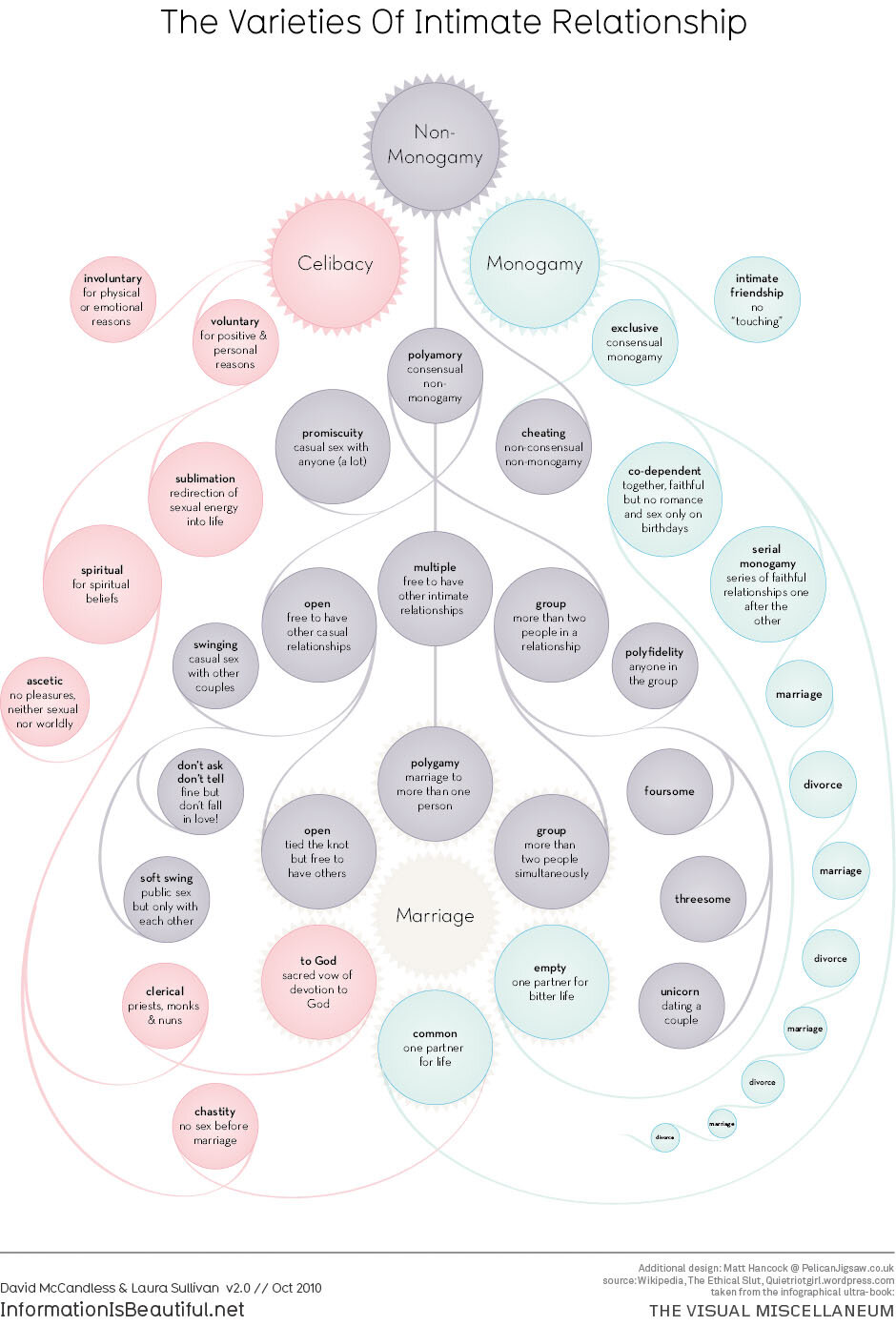
Non-monogamy isn’t new.
What might first come to mind in our country is the Mormon practice of polygyny, in which husbands would have multiple wives. But non-monogamy was also common and expected in many ancient cultures. As Dr. Michael Price of Psychology Today said: “Most ancestral men aspired to polygyny (even though most weren’t impressive enough to attract more than one wife), and some ancestral women preferred to be the co-wife of a really impressive man than the sole wife of a second-rate one.”
Theories explaining the shift to monogamy often point to the control of off-spring and resources and to Christianity. It became expected, presumed, and desirable to find your Mr. Right--your one and only for the rest of your lives. Many communities over the years fought to practice ethical non-monogamy, such as the New York Oneida community in the 1800s and the San Francisco Kerista commune in the 1960s until 1990s, yet we branded them as lustful sinners and crazy hippies. And today, we still live, dream, watch, read, and breathe monogamy. We’ve become pretty mono-normative.
What’s mono-normativity?
It’s the assumption that everyone is monogamous and wants a monogamous relationship. It’s also the fact that our systems are built for and around monogamy. This means that monogamous people have certain privileges in our society that non-monogamous folks don’t, despite the fact that an estimated half a million families in the U.S. are openly living in relationships between multiple consenting partners.
Think about it: single people, especially once they reach their late twenties, are often pestered about when they’re going to “settle down.” Marriage in the US is only legal between two people. Health insurance, taxes, and forms only cater to couples. Those of us raised on Disney princess movies dreamed of the straight, married, monogamous couple we would one day be a part of. People have lost jobs and children when the wrong folks discover their non-monogamy. This country’s institutions and social expectations are rooted in mono-normativity.
This week I stumbled across a pop culture example of mono-normativity that will hit home with the Outlander fans out there: I just finished reading a part in book six (I will purposefully be vague to avoid spoilers) in which a character is discovered to be sleeping with two twin brothers, both of whom she loves dearly. She gets pregnant from one of the brothers, and because the brothers are twins, she is unsure which one is the father. Upon her revealing the pregnancy, her father forces her to pick one brother, marries the two of them, and sends the other brother away. But the depth of their love for each other is touching: “[She] knelt on the floor, still clinging to the boys, the three heads drawn together like the lobes of a clover leaf as they murmured to one another. ‘Are you hurt?’ she was saying, and ‘Are you alright?’ they were asking, an absolute tangle of hands and arms meanwhile searching, patting, stroking, and embracing.”
Yet, evidenced in the forced marriage between only two of them to avoid scandal in their community, this triad clearly experienced the stigma of their time that non-monogamists still often experience today. A 2012 study found that many people still have negative stereotypes about people in non-monogamous relationships, believing them to be more sexually risky, less morally acceptable, and having less trusting and less meaningful relationships. The same study showed that people even thought that non-monogamists don’t floss their teeth as often or pay their taxes on time at the same rate as monogamous people, which is absolute nonsense.
In fact, researchers found that folks in ethically non-monogamous relationships are just as satisfied, committed, and passionately in love as folks in monogamous marriages. So while the stigma is real, the data show something different.
Regardless of your opinion on non-monogamy, however, knowing how to build healthy relationships is an important life skill for all of us.
And believe it or not, non-monogamists have some relationship tips that may be helpful for EVERYONE. Below are 4 tips that I hope can be useful for anyone wanting to grow and strengthen the meaningful relationships in their lives:
Communicate, communicate, communicate!
Folks engaged in ethical non-monogamy tend to be stellar communicators. Opening up a relationship requires intentional communication about boundaries, trust, hard emotions, and needs/wants. Those things are important in monogamous relationships, too! A lot of times, especially because of the state of sexuality education in this country, we’re not very practiced at having tough conversations with our romantic or sexual partners when things aren’t going exactly how we hoped or when something our partner did or said rubbed us the wrong way. We convince ourselves that maybe it’s not important enough to bring up--”I’m probably being irrational”--or we go straight towards laying blame on our partner(s) and fueling anger and bitterness. Making the time for intentional conversation with your partner(s), learning to confidently and respectfully communicate your needs and wants, and being vulnerable about your feelings with someone else can all help a relationship grow stronger and more loving.
2. Dare to feel.
Anger, grief, loss, sadness, fear… these can be really tough emotions to feel, especially when someone else caused us to feel that way. A tendency many of us have in our romantic or sexual relationships is to jump straight to the feeling of jealousy, rather than experiencing the harder emotions underneath it all. For example, am I really jealous that my boyfriend is hanging out with a good female friend or am I perhaps feeling lonely? Could my “jealousy” be alleviated if I reached out to some old friends to reconnect? Or might I feel better if we had a date night soon to celebrate us, since we haven’t had special together time in a while? Being curious about our emotions and digging into them, even the tough ones, can be really hard but also really important to maintaining healthy boundaries and contentment within relationships. Dare to feel the things. Be curious and dig deeper.
3. Rely on trust, not rules.
Any relationship, even if it’s friends with benefits or a random hook-up, requires a certain degree of trust. You have to trust that the other person is going to respect if you say “no” or “stop.” You have to trust that your emotions will be valued. You have to trust that your partner is not going to break agreements you made together.
A lot of us, even folks engaging in non-monogamy, often create a lot of rules around our relationships rather than relying on trust. Come home for family dinner or else. You’re allowed to kiss her but don’t have sex with her. You can’t talk to your ex. And the number one for monogamists: don’t cheat. What if these issues opened up a conversation rather than creating a hard and fast rule? What if the rules became questions: how can we adjust schedules so that family dinner works for all of us? Is there a reason that’s keeping you away from home so much? Why am I feeling jealous? And for the ultimate “don’t cheat” rule, what if we asked earlier enough: what’s missing for you and how can we work on that? Of course, not all relationships are healthy and can stay together. By relying on trust and conversation, you’ll find that there could be room to grow together or that you need to part ways. But either way, trust is maintained.
4. Be generous with your love.
Monogamists operate under the assumption that our love is finite. We can only love one person and for the rest of our lives. However, we know that not to be true: we love our kids. We love our family. We love our favorite barista. We love our friends. We love our favorite band. We love our communities. We know that there are so many different types of love, and the love doesn’t run out. Even if we’re stressed or sad and might be in a need of a little self love, deep down we still love others. Especially during this time when our black friends and community members are struggling against our unjust system, when our communities are being ravished by covid-19, and when our politicians are sowing hatred and fear against our fellow Americans and asylum seekers--this is the perfect time for us to realize that we must be generous with our love. Love is unbounded.
Regardless of whether you’re coupled, thrupled, or more, I hope these tips prove useful in helping promote even stronger relationships. You all deserve it.
To learn more about non-monogamy, check out the Multiamory podcast and the books Opening Up by Tristan Taormino and The Ethical Slut by Dossie Easton and Janet Hardy.